When I became interested in visual literacy skills I had trouble finding an assessment that would work for my students, so I created one of my own. View this sample assessment I completed with Henry, a fifth grade student.
Assessment of Visual Literacy Skills
In considering this topic for my Master’s thesis, I intended to find a proven assessment of visual literacy (V. L.) skills to evaluate my students’ skills. When researching the availability of such tests, I only found one specific Visual Literacy Skills assessment online designed by a Graduate student at Solent University in the United Kingdom. Cardine Rackham used photography as the medium to assess visual literacy skills (2004). Photographs were used to test observational, interpretation, analytical skills in relationship to compositional elements, and emotion-based signifiers.
I utilized the assessment with a student that I will refer to as Henry, a fifth grade student, who I saw at a private learning center for reading comprehension and attention difficulties. After extensive reading assessments, I discovered that Henry struggled with recall, vocabulary, poor cause and effect skills, unregulated metacognition skills, focusing, and low frustration tolerance.
Question 1
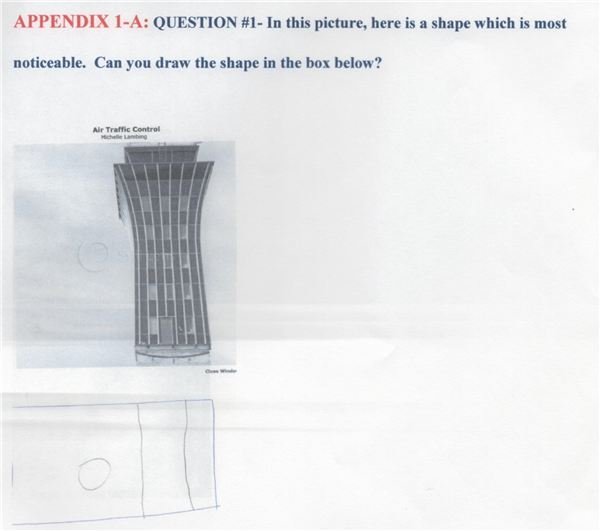
In question #1, (Appendix #1A), Henry showed the ability to understand the compositional element of shape, by identifying and drawing the primary shapes in the picture.
Question 2
Henry analyzed the picture’s visual signifiers to correctly determine the emotion in the picture of the woman migrant worker and her two children.
Henry said the following about this picture: “(The woman) is sad because she is crying. (She is) confuse about something (that) could have happened and she doesn’t understand how it happened.” Teacher prompt: “How do you know the woman is sad?” Henry responded: “The way she is posing and leaning on her hand.”
Henry indicated by his answer that he was able to “read” the visual cues, and draw a conclusion about the emotional context of the picture.
Question 3
Henry correctly identified the purposes of three photographs in terms of their genres – advertisement, newspaper, and CD cover.
He knew that none of the images belonged in a photo album, a fourth choice. Though not a validated scientific measure, Henry’s performance on this test revealed that he had possessed some basic visual literacy capabilities.
References
- For a complete list of resources, please see the first article in the series.
This post is part of the series: The Importance of Visual Literacy Skills
Being literate in the 21st century means more than simply being able to read. We are exposed to massive amounts of media every day. Teachers of K-12 students should focus on visual literacy skills to improve their student’s success. This series explains more about this concept.