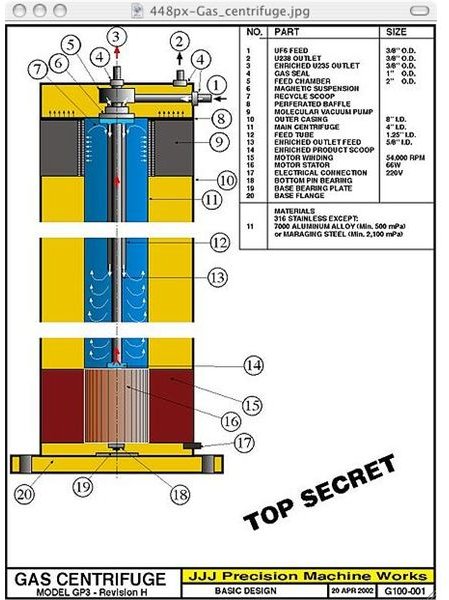
Centrifuges are serious machines used in medicine, science, in space testing and exploration and more, but the active principles of the centrifuge motion are all around us. Just how does a centrifuge work? The science involving physics has a way of explaining it best and we explore that here.
The Basics
“Etymology ” is a great word and an even better study. It means the mixture of words from languages used in the past. In Latin, there is a word meaning “flight” called fugue, and the Greek word for “center” is centr. Put them together and you have the word, centrifugue; and if you put the meanings together, it is put into flight away from the center.
So centrifuge, pronounced sen-tri-few-g, is a machine that creates a force that tends to move particles rotating around an axis outward from the center of rotation. Whoa! That seems like a lot to take in but in physics—the study of property and the interaction of matter and energy—centrifuge forces happen all around us. So how does a centrifuge work? We’re getting there…
The Two Often Go Together
There are two words in science that are often used together even though they mean the opposite: centrifugal and centripetal.
Centrifugal: moving away from the center or axis
Centripetal: moving toward the center or axis
Click here for a larger stylized diagram of a gas centrifuge illustration
Uniform Circular Motion
There are a ton of examples of things moving in a circle or uniform circular motion . When children ride a merry-go-round, they are spun in a circle; when you make a yo-yo go “Around the World,” it is spun out and around; and when your clothes spin in a washing machine, they are in a simple type of centrifuge as they are spun out to the edges of the machine’s drum in the hopes of getting the water out of them to then be put in the dryer.

What else? At the amusement park, a popular ride is the Tilt-A-Whirl. Have you been in a car that spins around from the axis? How about when your mom is making a salad? Does she use a salad spinner? And forensic scientists use it when they put blood into a tube and spin it round in a centrifuge to separate it out for
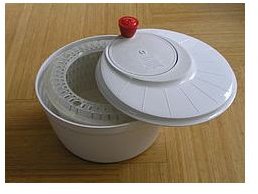
DNA analysis . The scientist, in fact, is separating the red blood cells from the plasma, which appears yellowish gray. The heavier red blood cells fall to the bottom of the tube when spun in a centrifuge and the plasma rises to the top. The forces created by the spinning machine push inward against the blood cells and separate them out.
In physics, the speed of the object in a circular path can be calculated or figured out in terms of the time required for the object to make one complete revolution or one trip around a circular path. The speed is a constant, so the time required to make that circle trip is called the period of motion.
Centrifuge Properties
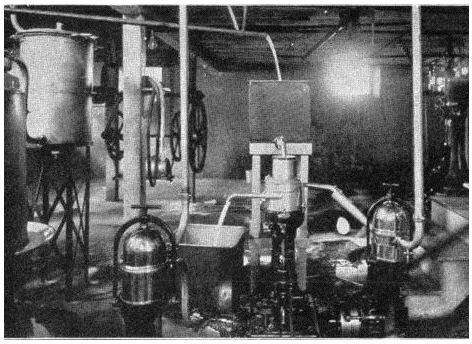
Since the centrifuge is a machine for separating mixtures of solid particles and immiscible liquids—two or more liquids that will not mix together made up of different densities, it extracts liquid from the wet solids by rotating them in a container at high speeds. In the photo at left, the dairy industry uses centrifuges to separate the cream from the milk.
You can create your own force by tying a string to an object and whirling it over your head in an arc—a portion of a curved line. (Careful now, this is a missile in motion.) That “force” you are creating exerts a pull.
So What is Centripetal Force?
Centripetal—pronounced sen-trip-it-ul—is language for “center seeking.” Remember, centripetal force is the center-seeking force on an object at every instant that pushes the object into a circular path at a constant speed. Another way to explain it is this: there is always a centripetal force when things move in circle; but, there is no force that pulls an object away from the center. No, it actually has to be pulled towards the center in order to maintain that circular motion and it is called centripetal force. Most people have the incorrect notion of this and think of “centrifugal force,” and now you can tell them what’s what.
A good example of this is the Earth going around the Sun —the centripetal force is gravity, and that pulls objects toward the center.
Sir Isaac Newton —the famous author of the theory of gravitation—has a description that says: “A centripetal force is that by which bodies are drawn or impelled, or in anyway tend towards a point as to a center.”
Resources & References
Image Credits:
Eden, Janine and Jim. Tilt-A-Whirl. Creative Commons Attribution 2.0 Generic license, https://www.flickr.com/photos/edenpictures/3961530764/
Wikimedia Commons/Public Domain, https://en.wikisource.org/wiki/The _New_Student%27s_Reference_Work/The_Dairy_Industry
Lymantria. Salad Spinner. Wikimedia Creative Commons Attribution-Share Alike 3.0 Unported license, https://commons.wikimedia.org/wiki/File:Slacentrifuge.jpg
Wikimedia Diagram Image/Webber Centrifuge. Public Domain, 2005, https://commons.wikimedia.org/wiki/File:Gas _centrifuge.jpg
Websites:
DNA Extraction, https://serc.carleton.edu/microbelife/research _methods/genomics/dnaext.html
See a video where a yo-yo goes around the world: MasterMagic.Net, https://www.mastermagic.net/TrickVideo/Beginner/Frames/AroundWorld.html
Books:
Hammond, Richard. Can You Feel the Force? Dorling Kindersley, 2010.
Dennis, Johnnie T. and Gary Moring. The Complete Idiot’s Guide to Physics, Alpha Books, 2006.