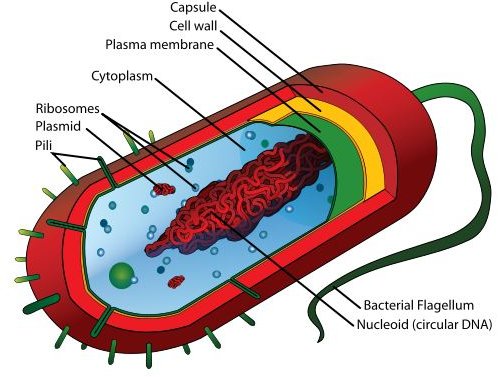
Need a biology homework guide to help you understand the role of flagella in prokaryotes? Read on to learn how these tiny living motors allow cells to move around.
Tiny Miracle
The role of flagella in prokaryotes are very important. Simply put, the flagella of a prokaryote allow the cell to travel freely from place to place. Without flagella, prokaryotic cells would not be able to travel and this would risk allowing these cells to become extinct.
Luckily for prokaryotes, its locomotion is provided by countless numbers of flagella which can be noted as a tiny modern marvel of transportation.
Composition of Flagella
A single flagella is often called a “flagellum” while multiple flagellum are called flagella. Each flagellum is made up of a monomer of globular protein called “flagellin.” The flagellin is made of the “filament” which is composed of a triple helix and a hollow core.
When a flagellum is being made, the flagellin molecules move through the filament and begin to compose the flagellum at the end of the triple helix.
At the end of a filament is a “basal end.” The basal end is composed of a L and a P ring followed by a rod and completed by a S and M ring. The basal end can be thought of as the rotor of a motor that propels the prokaryotic cell.
If you are having trouble with this description, think of the flagella as a building. At the foundation is the flagellin which roots the flagellum into the cell.
The flagellin has a triple helix with a hollow core called the filament. Both the flagellin and the filament provide a foundation for the additional creation of flagellum. The house itself is completed by the flagellin molecules which go through the filament and build the last part called the basal end.
Complexity of Flagella
Now that we have several flagella completed, we need to know how the flagella in prokaryotes operate. If you recall, the basal end of a flagellum is the flagellum’s form of locomotion. Basically, the flagellum “beats” its basal end in a rotary movement. In one sense, the basal end can almost be thought of as a motor boat’s propeller which allows the boat to move in the water.
According to Helena Curtis and N. Sue Barnes in Biology, the bacteria species Spirillum serpens flagella has been clocked at over 2,400 rpm! Just as a motor boat needs fuel to power its engine, flagella is often thought of being powered by chemiosomotic power.
So are flagella constantly moving? In a sense, no. Certain flagella types move by “runs” in that they beat once per second. Think of a person in a rowboat using their paddles against their paddles in one motion. Just as a row boat can glide across the water with one push of the paddles, so too can the prokaryote’s flagella propel the cell across a medium.
Other flagella types also use “runs;” however, they change direction through “tumbles” in which the flagella start in a new direction. An interesting aspect of “tumbling” is that when the flagella rotate counterclockwise they are in “runs” while when the flagella rotate clockwise they “tumble” and allow the cell to move in a different direction.
The flagella of prokaryotes are one of the most complex parts in a cell. These tiny locomotion motors allow the cell to move and with a diameter of 12-18 nanometers, flagella can arguably be thought of as one of the most complex and smallest engineering marvels of our world today.
It’s amazing to think that something so small can allow the cell to move and even compete without own transportation methods.
References
Source:
Curtis, Helena and N. Sue Barnes. Biology.5th ed. New York: Worth Publishers Inc., 1989.
Images:
LadyofHats. “Average Prokaryote Cell.” https://commons.wikimedia.org/wiki/File:Average _prokaryote_cell-_en.svg
Trekphiler. “26’ Ford T Engine.” https://commons.wikimedia.org/wiki/File:%2726 _Ford_T_engine.jpg
This post is part of the series: All About Prokaryotes
This series provides some vital information about prokaryotes including some of their functions and how they reproduce.