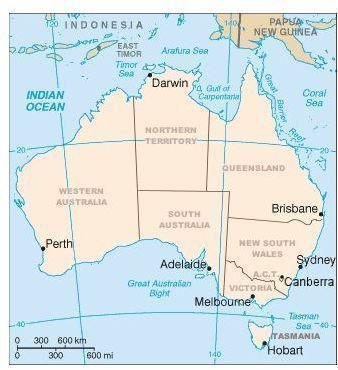
Australia is a wonderful place to work and live. This article will explain why as we explore Australian culture and values. In addition, a brief history of Australia will be given, and the reader will be tasked with learning how Australia became the nation it is today.
A Brief History
Australia was first inhabited by Aboriginals between 40,000 to 60,000 years ago. The culture of these people spread across this large continental nation, and many of them still share cultural links, such as the indigenous creation narrative “Dreaming.” This narrative describes the process by which the world was constructed by the creation spirits and ancestors of the Australian Aboriginal peoples, such as the Mardu of Western Australia. As well, many of the legends and stories associated with the Dreaming narrative can be seen in the landscape of Australia, in the rolling hills and winding rivers. In Aboriginal folklore, this natural landscape has a place in the origin of humanity.
After the arrival of the Aboriginal peoples between 40,000 to 60,000 years ago, European explorers discovered Australia for themselves. They first visited sometime in the early seventeenth century; however, it wasn’t until the mid-to-late eighteenth century, in 1770, when navigator James Cook arrived on the East Coast of Australia and claimed it for Britain. By 1778, the first European settlement was established on the island by Great Britain.
Following this, Australia became a colony of Great Britain and in particular, routinely was used as a penal colony. It wasn’t until 1901 that Australia became a Commonwealth. Australia participated in World War I following this and afterward declared independence as a sovereign nation.
Australia participated in World War II as well, fighting in both the European and Pacific theaters on the side of the Allies. Following WWII, Australia saw a period of boom and immigration and has entered into the 21st century a strong, democratic, independent nation.
The Culture
Australia is, first and foremost, a multicultural, English-speaking, democratic society. Boasting an indigenous population of 520,000 persons, the indigenous population makes up 2.5 of the more than 22 million Australians on the continent. This, however, is just the beginning when one discusses the multicultural aspects of Australia’s culture.
Since 1945, Australia’s previous population of 7 million peoples has harbored more than 6.5 million migrants. As well, more than 43 percent of Australians were either born overseas or have a parent who was born overseas. This mass immigration from regions of the world including Europe, the Asian Pacific, the Middle East and Africa, have lent to the multicultural make-up of Australians more than any other factor. In total, more than 43 percent of Australians were either born overseas or have a parent who was born overseas.
Australia’s culture has been influenced strongly by its people’s pioneer, settler lifestyle. As quoted from a site about Australia, “Australians believe in mateship and a ‘fair go’…These values stem from convicts and early colonialists who struggled against a harsh and unfamiliar land and often unjust authority.” (1) In short, the pioneer lifestyle of early European Australians has instilled an underdog instinct into Australian culture, blending well with the influx of immigrants into the nation.
The Values
Following a discussion of culture among Australians, it is perhaps pertinent to discuss the values associated with being Australian. As previously mentioned, Australians value a “fair go,” that is to say, the chance for each and every person to succeed if they apply themselves. However, that is not the only value cherished among Australians. In this section, some of the most important of these values will be mentioned.
Equality among all, whether they are man or woman, no matter the person’s ethnicity, is a value upheld in law in the nation of Australia. Equality is a must-have in this nation that, as previously noted, demands a “fair go.”
Freedom of speech and association, of religion and secular government, is another value not only upheld in law, but also in the ingrained culture of Australians. In the construction of a society in this one-time penal colony of Great Britain, freedom is essential.
Democracy, an institution that is closely tied in with the aspects of freedom, is another value which is essential to the identity of Australians.
Egalitarianism, a value that originated perhaps with some of the Aboriginal peoples of Australia, has found a home in the modern Australian culture. A value that encompasses beliefs similar to that of the equality laws, egalitarianism, however, notes that none should be discriminated or held back due to someone’s country of birth, cultural heritage, language or religious belief.
References
(1) Australia: Australian Culture – Tourism Australia, https://www.australia.com/about/culture.aspx
Australian Government Department of Immigration and Citizenship: Values and Law, https://www.immi.gov.au/living-in-australia/choose-australia/about-australia/values-and-law.htm
Howgego, Raymond John. Encyclopedia of Exploration to 1800. Potts Point NSW: Hordern House, 2003.
Image credit:
Map of Australia by Mark Ryan under GNU Free Documentation License .