This poetry lesson plan offers means of teaching students about poetry, subtext and, implicitly, morality all at the same time through the exploration of lie poems.
First Things First
Because “lie” is a charged word and a strong one for very young children, you might open by engaging in a light exploration of the term
“lie.”
The discussion of lying should grab students’ attention right away. There is a “shock” element to the term and yet a sense of familiarity, as children are often known to use the word themselves.
Explain to students that lying—the altering, stretching or “forgetting” of the truth, is not an ideal or appropriate way to cope with situations that make us uncomfortable in life.
All that being said, it can make for colorful and creative poetry.
Model
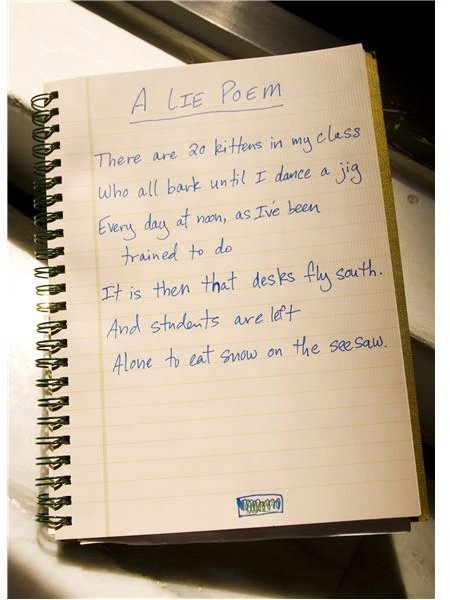
Share an example of a relevant Lie Poem.
Here is an anonymous Lie Poem you may use in this poetry lesson plan, written from a teacher’s perspective:
LIE POEM
There are 20 kittens in my class
Who all bark until I dance a jig
Every day at noon, as I’ve been trained to do.
It is then that desks fly south
And students are left
Alone to eat snow on the seesaw.
Beneath Lying
Although they can be silly and fun, often lie poems capture a sense of realism or contain underlying truths that can introduce very young students to the concepts of subtext or wish fulfillment on a basic level.
You might explore in the above poem or an example you provide yourself what truths can be found within the sometimes silly-sounding text of the lie poems. For example, above, students are compared to curious kittens whose enthusiasm and questions help their teacher to unwind and embrace life’s simple pleasures (like teaching students) throughout the day. Or is it that cute little tots become mischievous chatterboxes who goof off and run about so much in the mornings that their teacher looks forward to lunchtime everyday?
New Lies, Old Truths: The Next Generation
After dissecting the layers of the Lie Poem, students will be prepared to write their own poems.
Emphasize again that the place for lies, the only place for lies, is on paper in creative writing. From such lies come wonderful truths, which are so inextricably linked to great art. Offer them, then, the chance to create some great art.
Instruct them to write a Lie Poem by saying something in every line that is not true or, as an alternative, simply making the whole poem about something that is not true.
After they’ve written their poems, have them share. Enjoy the silly sounds and aesthetic surface with the students, and explore the deeper subtext.
Include this lesson plan in your series of lessons celebrating National Poetry Month .
Photo © Zak Shelby-Szyszko