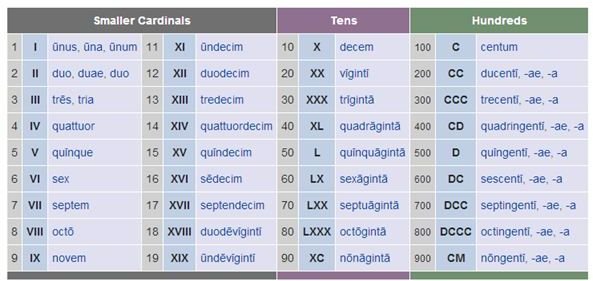
Latin cardinal numerals are quite simply once the Latin student understands the conventions used to form and decline Roman numbers. Learn how to decline the first three cardinal numerals in Latin and how to use them in proper Latin grammar.
Both English’s and Latin’s most common numerals are the “cardinal” numbers. The word “cardinal” itself is derived from the masculine
Latin noun “cardo, cardinis” which means “hinge.” It is appropriate to call the most common numerals “cardinal” because they represent pivotal numerals in both languages.
Cardinal numerals can be contrasted with ordinal numerals which are used to indicate rank or order such as first, second, third, etc.. The word “ordinal” is also derived from Latin in the word “ordo, ordinis” which literally means “rank” or “order.”
Most of the Latin numerals from 1 to 100 are indeclinable adjectives . This means that they do not change their form to match the case and gender of the word they modify. Typically, an indeclinable numeral is simply placed next to the word it modifies so as not to create confusion in case there are two or more words in a sentence that the numeral could modify.
However, the Latin numerals “unus” (one), “duo” (two), and “tres” (three) do decline to match the word they modify in case and gender. Notice that there is no reason for these cardinal numbers to match in number because by nature of the meaning of these numbers, there are no plural forms for “unus” and no singular forms for “duo” and “tres.” With case and gender alone, they, by default, must also match the number of the word they modify. Read on to learn how to decline “unus,” “duo,” and “tres” in Latin sentences.
How to Decline Latin’s Cardinal Numerals – Unus
Unus, una, unum declines a bit strangely because it does not decline, as expected, like a second-declension adjective. “Unus” declines similarly to “ille, illa, illud” with the unexpected –ius ending in the genitive and the –i ending in the dative. The nominative, accusative, and ablative forms of “unus,” however, decline as expected. For example:
unus (m) una (f) unum (n)
unius (m, f, & n)
uni (m, f, & n)
unum (m) unam (f) unum (n)
uno (m) una (f) uno (n)
Remember that by nature of what “unus” represents (the cardinal number one), it has no plural forms.
How to Decline Latin’s Cardinal Numerals – Duo
“Duo, duae, duo” represents Latin cardinal numeral “two” and declines as follows:
duo (m) duae (f) duo (n)
duorum (m) duarum (f) duorum (n)
duobus (m) duabus (f) duobus (n)
duos (m) duas (f) duo (n)
duobus (m) duabus (f) duobus (n)
Remember, again, that by nature of what “duo” represents, it has no singular forms. It cannot possible modify a word in the singular.
How to Decline Latin’s Cardinal Numerals – Tres
“Tres, Tria” represents Latin cardinal number “three” and unlike “duo” it declines similarly for each case in the masculine and feminine but has a separate form in the nominative and accusative case for the neuter gender. For example:
tres (m & f) tria (n)
trium (m, f, & n)
tribus (m, f, & n)
tres (m & f) tria (n)
tribus (m, f, & n)
Like “duo,” “tres” has no singular forms because “three” is inherently plural.
How to Translate Cardinal Numerals in Latin
Using Latin cardinal numerals in translation is quite simple once the forms of “unus,” “duo,”
and “tres” are memorized. Remember that the remaining cardinal numerals from 4 to 100 are indeclinable; they always have the same form regardless of the word they modify. For example:
Unus puer in via ambulat. (One boy is walking in the road.)
Decem pueri in via ambulant. (Ten boys are walking in the road.)
Libri trium feminarum magni sunt. (The books of the three women are great.)
Libri quattuor feminarum magni sunt. (The books of the four women are great.)
Notice that “decem” and “quattuor” are indeclinable and do not change their form regardless of the case and gender of the word they modify.
Once You Get Past Unus
Roman cardinal numerals between 1 and 100 are quite easy to translate once the forms of “unus,” “duo,” and “tres” are memorized. This is quite simple since “unus” has no plural forms and “duo” and “tres” have no singular forms. The rest of the cardinal numerals from quattuor (4) to centum (100) are indeclinable and have the same form regardless of the case and gender of the word they modify .