Start learning Japanese writing. Master the writing of hiragana by applying accent and stroke order in to your technique.
Hiragana
There are four scripts in Japanese writing. Hiragana is one of the four scripts in Japanese writing. Hiragana has 46 characters which is similar to katakana.
Hiragana characters do not have any particular meaning in and of themselves. Rather, hiragana is used to represent the basic syllables in Japanese speaking. Regard hiragana in the same way that you might the letters in the English alphabet.
Hiragana takes on a whole new role in grammatical structure, especially where there are functions needed for changing tenses in verb forms or to precede nouns. Hiragana is often combined with kanji. Kanji are the Chinese characters adopted by the Japanese language. Hiragana is extremely important to the use of Kanji in the Japanese language.
Okurigana
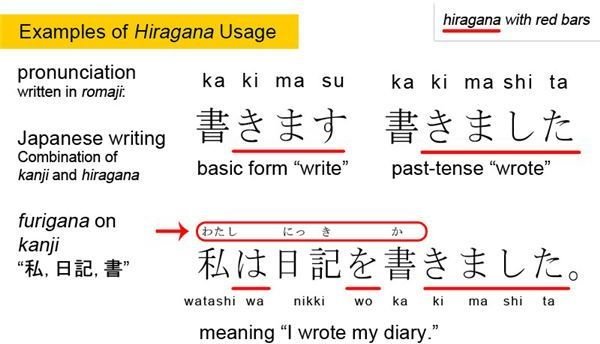
When hiragana is added to the end of words represented by kanji to modify meaning, the hiragana counterpart of the kanji is referred to as okurigana. Here is an example of hiragana usage in a sentence:
Kakimasu (write) is a verb that can be changed into a different tense, such as kakimashita (wrote). Hiragana is used to change the tense of the verb for “write” into “wrote”.
Furigana
Hiragana is commonly used as an article in a sentence. The example, watashi wa nikki wo kakimashita in the image shows that the article “wa” is preceding the subject, watashi. The particle wo is preceding the noun nikki, which is the object that the subject, watashi, wrote.
There are some usages called furigana to assist in the pronunciation of particular kanji that have unusual usage or are rarely used. Furigana appears on top of these kanji, as the example in the image shows.
Another usage for hiragana is its application in Children’s (elementary school children) publications, including manga comics, children’s books, and school textbooks. These types of publications usually have furigana in any kanji. There is no kanji used in any books for children below the elementary level. Instead, hiragana takes place of kanji for very young learners.
Hiragana Stroke Order
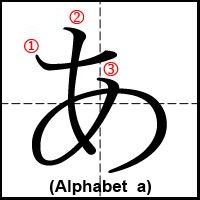
Learning the proper stroke order of hiragana is crucial in learning to write in Japanese. There are some complete hiragana charts online, which include an animation detailing the stroke order of each character. Reference this table of hiragana characters . Also see the hiragana master drill for the basic sounds: a, i, u, e, and o. Further your understanding of hiragana by visiting Yoshida Institute online.
Keep these tips in mind when writing hiragana in Japanese:
-
A character should reside in a perfectly square grid (2 crossed dotted lines in the center) to show the exact position of the hiragana. Learners can estimate easily where each stroke begins and ends.
-
A character used in old script writing/ font with a Japanese calligraphy brush is recommended for practicing writing hiragana. This way, the learner can clearly see how strokes work. There are accents in each brush stroke. Accents refer to the amount of pressure and stroke of the hand that is applied to the tip of the pen or brush. By tracing over the example image, a student can practice stroke orders and accents with a brush or pen on paper. Try to enjoy the practice of writing hiragana, and you will adjust to this foreign writing system more easily. Treat the learning of hiragana as a craft.