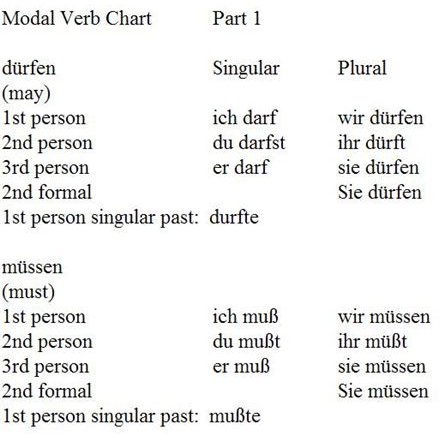
How to conjugate the seven modal verbs in German. The modal verb chart can be downloaded from the Media Gallery in the Language Learning channel.
What is a Modal Verb?
We have them in English, too – they’re the helping verbs that put conditions on verbs other than tense. “May” suggests permission; “can” suggests ability; “should,” obligation; “must,” duty or requirement.
In German, there are seven: dürfen (may), können (can), sollen (should, or supposed to), wollen (want to), mögen (like to), möchten (would like to), and müssen (must).
How do Modals Work?
In English, they usually come right before the action verb in a sentence. Here’s an example: “Bob can’t believe what just happened.”
The action verb is “happened.” The modal verb is “can.”
In German, though, modals work just like “werden” in the future tense: they send the action verb to the end of the sentence.
Let’s look at this English sentence: “She can go to the movies today.”
Here’s how that would look in German: “Sie kann heute ins Kino gehen.”
Here’s a look at how all seven modal verbs are conjugated in the present tense.
Modal Verb Charts
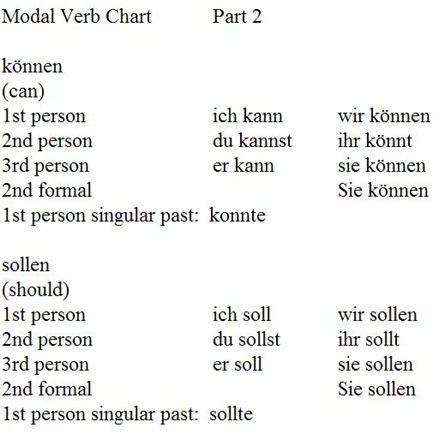
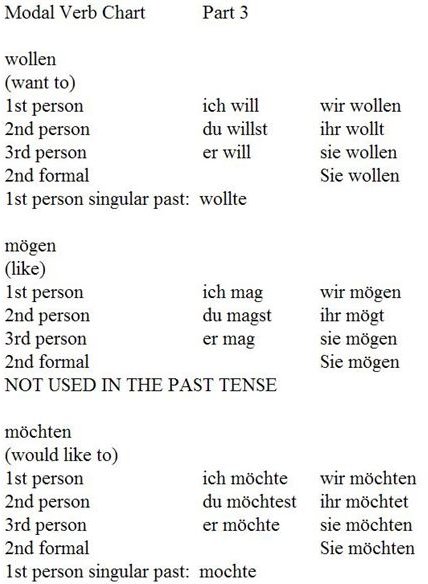
Modal verb chart
Please download the Modal Verbs Chart from the Media Gallary in the Language Learning channel.
Past and Future Tenses
Remember that chart? At the bottom, you may have noticed that the form for the first person, past tense for each modal was included. Here’s the entire past tense conjugation for wollen:
ich wollte, du wolltest, er wollte, wir wollten, ihr wolltet, sie wollten, Sie wollten.
Once you know the first person past tense form for each modal, you know how to conjugate the whole tense, because all seven verbs take the same endings.
Future tense gets a little clunky at the end of the sentence, but here’s the basics. Remember werden and how it works? Everything else gets sent to the end of the clause. Here’s an example:
“We will have to stay for three hours.”
In German, here’s how that would look: “Wir werden auf drei Stunden bleiben müssen.”
So the action verb becomes the next-to-last word, followed by the modal infinitive (bleiben means “to stay”).