Why is there interest in studying languages? To answer this important question, Noam Chomsky proposed linguistic theories. Chomsky’s language acquisition theories are the most important in the world of linguistics.
Chomsky Language Theories
One of the greatest linguists of all times, Noam Chomsky asserts that language is innate. He wrote his famous book, “Language and Mind” in 1972, in which he proposed his famous theories on language acquisition. In this book Chomsky wrote, “When we study human language, we are approaching what some might call the ‘human essence,’ the distinctive qualities of mind that are, so far as we know, unique to man." According to Chomsky, language is one characteristic that is unique to humans among all other living beings. Chomsky’s theories have made it easier to understand the evolution and development of the languages.
Chomsky’s theories on language are based upon the importance of linguistics in modern sciences. According to him, to study languages, it is important study human nature that lies in human mind.
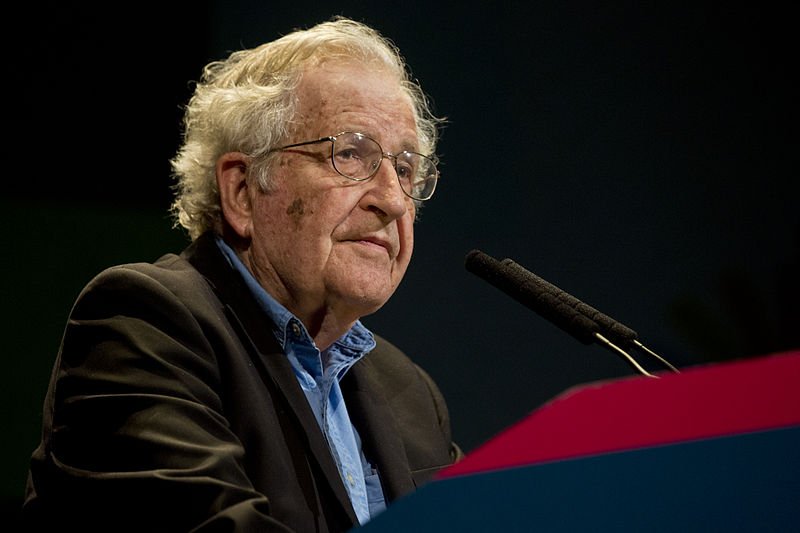
[caption id=“attachment_130295” align=“aligncenter” width=“800”]
Chomsky on Language Acquisition
Noam Chomsky postulated that the mechanism of language acquisition is derived from the innate processes. Innate is something which is already there in mind since birth. The theory proposed by Chomsky is proved by the children living in same linguistic community. Moreover, they are not influenced by the external experiences which bring about the comparable grammar. He thus proposed his theory on language acquisition in 1977 as “all children share the same internal constraints which characterize narrowly the grammar they are going to construct.” He also proposed that all of us live in a biological world, and according to him, the mental world is no exception. He also believes that as there are stages of development for other parts of the body, language development can also be achieved up to a certain age.
Another postulate of Chomsky’s language acquisition theory is the process of selecting the best grammar that matches with the data available. He related the structural linguistics with empiricist thoughts.
Chomsky on Generative Grammar
When talking about generative grammar, his views are different from structuralist theory. According to Chomsky, generative grammar should “render explicit the implicit knowledge of the speaker." He proposed a set of well-defined rules to generate required sequence of words. Individuals instantly decipher that a certain combination of words make sense and different combination does not make sense. The explanatory theory of generative grammar is beautifully demonstrated by the rules of the English auxiliary system.
Chomsky on Semantics
According to Chomsky, the field of linguistics does not include the study of meaning and reference and the use of language. According to linguistic theory, the concepts of the grammar are not based upon semantics, but linguistic theory should provide an explanation to the semantic phenomenon.
Conclusion
Chomsky rejects the idea that human mind is a clean slate at birth and is filled in by experience. He suggested that the there are components of mind which are innately determined about languages and other systems of knowledge.
Image by Augusto Starita / Ministerio de Cultura de la Nación - CC BY-SA 2.0