Exploring the world of early humans? Learn important vocabulary, people, and places to help you with homework and assignments on prehistoric times.
Prehistory Vocabulary
Use this study guide to help you prepare for a social studies test or just to help you with your homework assignments. It contains key
vocabulary, people and places that are important to remember when learning about evolution and early humans.
Prehistory: a time before written history.
Artifacts: objects made or used by humans.
Atlatl: a spear thrower
Archaeologist: someone who researches ancient cultures by examining their material remains.
Genome: a life form’s genetic material.
Anthropologist: one who studies human development, culture and behavior.
Fossil: the remains, no matter how small, of a living thing from a previous geologic age.
Hominid: human and human-like beings.
Paleontologist: studies fossil remains.
Radiocarbon dating: method for determining the amount of radioactive carbon left in organic remains and thereby determining its time of death. Radioactive carbon decays at a given rate.
Australopithecus afarensis: southern ape from Afar.
Ardipithecus ramidus : meaning ground ape and root respectively. It comes from the Afar language.
Bipedal: the ability to walk upright.
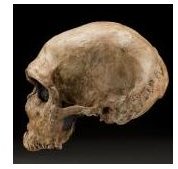
Neanderthal: likely the first thinking man. Named for the Neander Valley in Germany.
Cro Magnon: earliest modern man with progressed reasoning capabilities. They are not believed to be a separate species; the name designates the rock shelter in France in which the fossil remains were first found.
Ice Ages: Four extended periods of extreme cold that occurred between two million and ten thousand years ago. Ocean levels dropped during the four glacial periods causing land masses usually separated by water to connect. (i.e. - land bridges between Japan and mainland Korea, Great Britain and Ireland, Malay Peninsula and Indonesia, Asia and North America).
The Stone Age: used to describe the period of time predating writing in which early man used stone tools.
Paleolithic: Old Stone Age, ~ 2.5 million years ago to 12,000 BCE.
Mesolithic: Middle Stone Age, ~ 12,000 BCE to 8000 BCE.
Neolithic: New Stone Age, ~8000 to 5000 BCE.
Neolithic Revolution: Refers to the shift from hunting and gathering to agriculture that occurred following the last Ice Age. This shift dramatically changed the way people lived but did not occur at the same time throughout the world. This gradual change to agriculture can be seen as far back as 8000 BCE in the Middle East but not until sometime between 5000 and 4000 BCE in the Americas and China.
People and Places
Gen Suwa: Japanese anthropologist who discovered the first fossil remains of Ardipithecus.
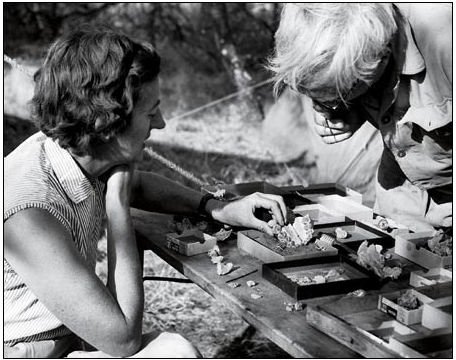
Mary and Louis Leakey: Famous paleoanthropologists who made significant fossil find in Africa, especially in the Olduvai Gorge. Their son Richard and his wife, Maeve, followed in their footsteps. (Image found at https://img.timeinc.net/time/80days/images/590717.jpg )
Hadar: location in Ethiopia where the remains of Lucy were unearthed in 1974.
Aramis: location in Ethiopia where the first fossil remains of Ardipithecus were found in 1992.
Afar: region in Africa.Vallon Pont d’ Arc and Lascaux, France-locations of cave paintings.
Catal Huyuk: an unearthed Neolithic village in modern day Turkey. It dates from 7000 to 6300 BCE.
Download this Human Evolution Worksheet , a useful study aid for your prehistory lessons, homework, or tests.