Two distinct types of reactions will generally be covered in a high school chemistry class: chemical reactions and nuclear reactions. What’s the difference, and how are they alike?
Nuclear vs Chemical Reactions
What is the difference between a nuclear and a chemical reaction? As it turns out, this is pretty simple. In a chemical reaction, the bonds between elements are broken and reformed to create new molecules that contain the same elements. For example, in the chemical equation 2H2 + O2 = 2H2O, we now have a new substance - water - but the underlying elements are the same.
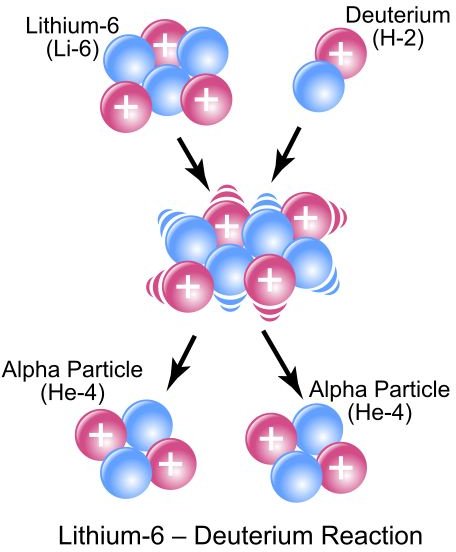
In a nuclear reaction, on the other hand, the nucleus of the element changes to make a new element. For example, bombarding lithium with neutrons causes the creation of tritium, a radioactive isotope of hydrogen which is extremely rare in nature.
Stated another way, a chemical reaction involves an atom’s electrons - bonds are broken and restored in the search for a more stable configuration - while a nuclear reaction involves the atom’s nucleus.
Energy
Another difference is the amount of energy required. While a chemical reaction requires or gives off a relatively small amount of energy through the breaking and forming of atomic bonds, a nuclear reaction gives off a large amount of energy through the splitting (fission) or fusing (fision) of atomic neclei.
Decay of Radioactive Elements
As with chemical reactions, not all nuclear reactions are man-made. A radioactive isotope randomly loses energy in the form of alpha particles , decaying into atoms that may be of a different type. For example, a carbon-14 atom may decay into a nitrogen-14 atom. In some cases, the atom remains the same element, but at a lower energy state.
Although the amount of time it takes for a given atom to give off an alpha particle is random, a large number of such atoms will give off particles at a predictable rate. This rate is known as the half-life, and is the amount of time it takes for half of the atoms to decay; the half-life can be trillions of years or a tiny fraction of a second. For example, Carbon-14 has a half-life of 5730 years , which means that if you start with a certain amount of C14, after 5730 years or so you should have half as much, then after 11,460 years or so you should have a quarter of the amount you started with, and so on. This reaction is used in carbon dating: the ratio of carbon-14 to carbon-12 in a living organism is know, but when something dies, the decaying carbon-14 is no longer replaced; as a result, we can estimate the age of a formerly living organism by taking a sample and comparing the relative amounts of C12 and C14.
Similarities
How are these two reactions similar? In both cases, we can predict how elements will combine by writing balanced equations; because matter and energy are neither created nor destroyed, we know that what we put into the system will be the same as what we get out, albeit possibly in a changed form. Both types of reactions are, of course, very important for our life here on earth!