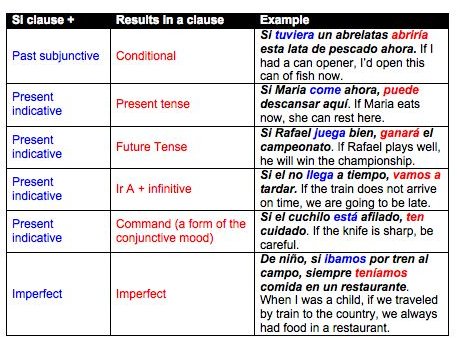
As in English where we use “if” clauses (e.g., “If you can read this without glasses…”) Spanish “si” clauses are used to express the hypothetical. The verbs used in these clauses are sometimes, but not always in the subjunctive mood.
When the Si Clause in Spanish Needs the Subjunctive
There is a saying in Spanish, Si mi tía tuviera ruedas, sería una bicicleta. (If my aunt had wheels she would be a bicycle.) This is an example of the use of the si beginning a hypothetical clause (a statement about improbability or something contrary to fact.) Since the connotation is obviously contrary to actuality, the si clause here uses a form of the past subjunctive of tener, followed by the a conditional tense of ser.
More si clause examples using the subjunctive mood followed by the conditional tense:
Si no hubiera leyes para proteger los ríos, estarían muy contaminados. If there weren’t laws to protect the rivers, they would be very contaminated.
Si Humberto sacara una foto de un oso, se iría contento de esta excursíon. If Humberto took a photo of a bear, he would come away happy.
When the Si Clause Does Not Use the Subjunctive
Si clause in the present, followed by main clause in the present
Si ustedes están cansados, pueden descansar un poco aquí. If you are tired, you can rest a little here.
Si clause in the present, followed by the main clause in the future
Si Andrés sigue el sendero llegará al campamento en dos horas. If Andrés follows the path, he will arrive at the camp in two hours.
Si clause in the present, followed by Ir a + infinitive
Si no lleva usted un suéter en su mochila, va a tene****r frío. If you don’t carry a sweater in your backpack, you are going to be cold.
Si clause in the present, followed by a command
Si el cartón está vacio, ponlo en el basurero. If the carton is empty, put it in the wastebasket.
Si clause in the imperfect followed by the main clause in the imperfect*
Si María tenía el dinero, siempre iba al cine los domingos. If María had the money, she would go to the movies on Sunday.
*Note: When the si clause speaks of a habitual past action that is not contrary to fact, the imperfect tense is used in both clauses.
A Recap of the Rules for Spanish Si Clauses
Read more about Spanish si clauses at:
e Learn Spanish Language - Si Clauses (Study the examples and take the quiz.)